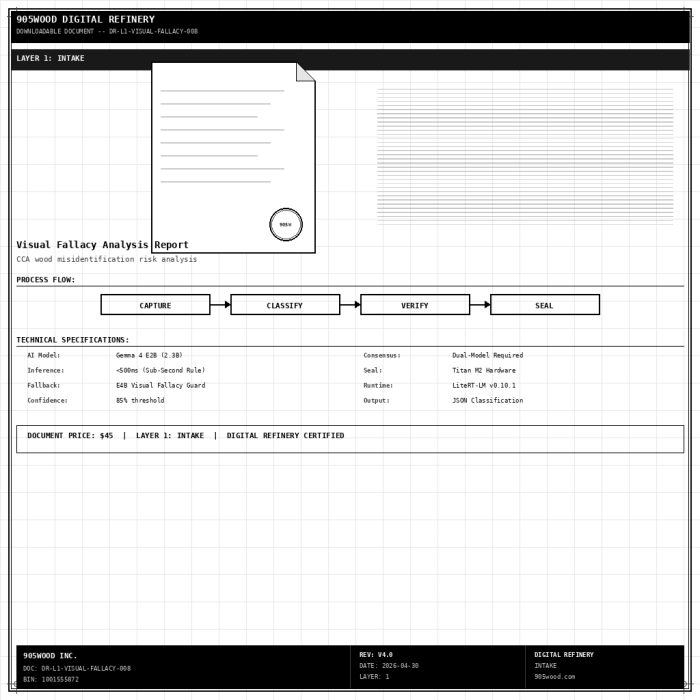
Visual Fallacy Analysis Report
In stock
- SKU
- DR-L1-VISUAL-FALLACY-008
Description / Visual Fallacy Analysis Report
Visual Fallacy Analysis Report - Economic and Regulatory Proof, Not Just Paperwork
The Visual Fallacy Analysis Report is built as a intake control document to stop the wrong load before it becomes mixed-rate cost, contamination expense, or a customer dispute. For 905WOOD customers, the value is not the file itself; the value is the ability to prove the decision, defend the charge, and keep the clean-wood strategy economically credible.
This document is designed for site teams, dispatch, and intake reviewers. It turns evidence into a faster decision path for operations while giving finance, procurement, and compliance teams something they can actually rely on.
It records why appearance alone could not be trusted, protecting the business from expensive false-clean decisions.
Regulatory pressure is rising across Ontario's disposal and recovery market. The January 1, 2026 municipal IC&I exit, the 2029 clean-wood landfill ban runway, and growing scrutiny around cross-border, carbon, and hazardous-material claims mean weak documentation is now a direct cost driver. This document exists to create auditable proof at the front gate, before a bad classification spreads downstream.
In short: the technology matters because it connects waste handling to money. Better evidence means lower avoidable cost, fewer failed claims, stronger pricing logic, and a cleaner path through audit or inspection.
More Information
| TCLP Pass | No |
|---|---|
| Precautionary Flag | No |
| HS Code | 3825.0 |
| CORC Yield Factor | 0.750000 |
| CORC Value ($/tonne) | CA$350.00 |