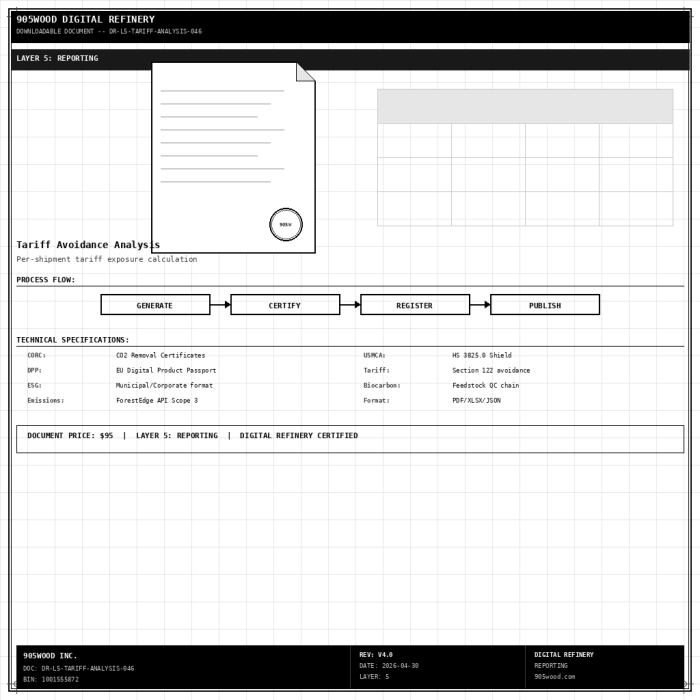
Tariff Avoidance Analysis
In stock
- SKU
- DR-L5-TARIFF-ANALYSIS-046
Description / Tariff Avoidance Analysis
Tariff Avoidance Analysis - Economic and Regulatory Proof, Not Just Paperwork
The Tariff Avoidance Analysis is built as a carbon, ESG, and cross-border value capture document to protect premium claims, quantify financial upside, and reduce tariff, trade, and credibility risk. For 905WOOD customers, the value is not the file itself; the value is the ability to prove the decision, defend the charge, and keep the clean-wood strategy economically credible.
This document is designed for executives, buyers, sustainability leads, customs brokers, and strategic partners. It turns evidence into a faster decision path for operations while giving finance, procurement, and compliance teams something they can actually rely on.
It quantifies trade-policy exposure before a shipment, contract, or routing plan turns unprofitable.
Regulatory pressure is rising across Ontario's disposal and recovery market. The January 1, 2026 municipal IC&I exit, the 2029 clean-wood landfill ban runway, and growing scrutiny around cross-border, carbon, and hazardous-material claims mean weak documentation is now a direct cost driver. This document exists to convert documentation into usable proof for buyers, auditors, customs brokers, and reporting teams.
In short: the technology matters because it connects waste handling to money. Better evidence means lower avoidable cost, fewer failed claims, stronger pricing logic, and a cleaner path through audit or inspection.
More Information
| TCLP Pass | No |
|---|---|
| Precautionary Flag | No |
| HS Code | 3825.0 |
| CORC Yield Factor | 0.750000 |
| CORC Value ($/tonne) | CA$350.00 |